









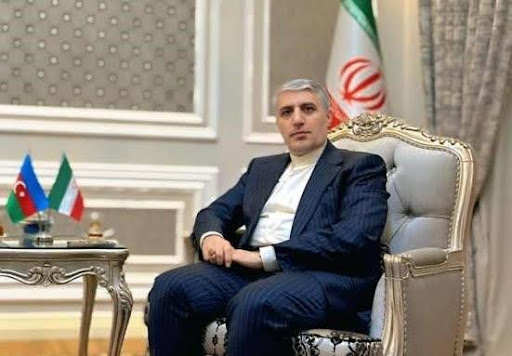

Iranian Ambassador Reveals Details: "New Conditions Will Be Established" — EXCLUSIVE INTERVIEW
"Some of Our Losses Are Irreplaceable"
08 April 2026
Interview with Mujtaba Damirchiloo, Ambassador Extraordinary and Plenipotentiary of the Islamic Republic of Iran to Azerbaijan, for Pressklub.az
— Mr. Ambassador, thank you for the interview. First, let us discuss the agreement reached last night between the Islamic Republic of Iran and the United States. Is the ceasefire being observed? How has the situation been in recent hours?
— We did not start this war. We genuinely wanted there to be no war. Unfortunately, the other side demonstrated — both during last year's 12-day war in June and in the war that began on February 28 of this year — that they were not genuinely interested in negotiations or reaching an agreement. Rather, they wanted to dictate their demands upon the other side. Despite this, we were conducting negotiations in January and February, and most regrettably, for the second time, our country was attacked precisely while talks were underway. Under such circumstances, we had to defend ourselves, and this is a right recognized under international law. Naturally, their attacks continued, and we had to respond accordingly — and we did. There were some efforts, particularly by Turkey, Pakistan, and Egypt, to help stop the war. They sent a 15-point document, the essence of which amounted to nothing more than an ultimatum and capitulation. There was nothing reasonable in it that could be amended. They assumed they would achieve their objectives through military operations within three to four days, even though their demands were fundamentally baseless. They thought they would reach their goals, but saw that this did not happen. They then attempted to achieve the same through a 15-point framework. Naturally, Iran could not accept this, and we drafted our own conditions and demands and presented them to the other side. As you noted, last night a situation arose in which they indicated readiness to begin negotiations based on Iran's proposal, and simultaneously a two-week ceasefire was declared. Considering that this decision was announced at approximately 4:30 AM, a few incidents still occurred afterward. Nevertheless, we can say that the situation has fundamentally changed, and the intense strikes from both sides have now been halted. We hope this process will continue, that the fire will fully cease, and that negotiations will begin. However, the other side's behavior raises certain questions — are they genuinely interested in a comprehensive resolution, or are they merely buying time to prepare for a new war? In this regard, Iran believes that work must be done toward lasting peace, as a ceasefire alone is insufficient.
— The ceasefire agreement was reached against the backdrop of threats by the United States to destroy Iran's vital infrastructure, including power stations and bridges. What does the initial agreement cover? How is it that an agreement that previously seemed unattainable was reached precisely under these threats?
— When they launched the war, they struck both military and civilian targets. Over the course of the conflict, the number of non-military targets that suffered damage only increased. As you mentioned, just the other day, eight bridges were hit. None of them were military targets. All of those bridges were civilian infrastructure — located on both railway and highway routes. At the same time, three days earlier, you heard that a major bridge near Tehran was also targeted. They claimed this was to prevent its use for military purposes. However, that bridge had not yet been put into operation; it had only been completed and made ready. Everyone knows that this bridge connects Tehran's northern regions, passing through mountainous terrain toward the Caspian Sea. The movement of large transport vehicles there is practically impossible. Therefore, the arguments put forward are baseless, and everyone understands this. My point in saying this is that in recent days we have witnessed attacks on civilian targets — particularly in the energy, transport, industrial, and manufacturing sectors. It is noteworthy that a ceasefire agreement was suddenly reached amid such intense and sustained strikes. It appeared as though there was no groundwork for it, yet an agreement materialized. At the same time, it is understood that any agreement does not emerge suddenly. Behind it lie days of direct and indirect negotiations, exchanges of messages, and mediation by third parties. In other words, these processes are not such that one side issues a threat and an agreement follows shortly thereafter. For example, the 15-point proposal you mentioned, or Iran's 10-point counter-proposal, demonstrates that these documents were worked on for days, prepared, and at a certain stage the parties reached an accord.
— The initial demands of the United States and the Israeli coalition included the limitation of Iran's nuclear industry, long-range missiles, reduction of support for proxy forces, and so on. Iran stated that these were its "red lines." In this regard, does the ceasefire proposal cross those red lines? Because there is contradictory information: the US declares that they have won, that it is a total victory, while Iran's Supreme National Security Council states that its 10-point conditions have been accepted. In other words, the media needs some clarity. As ambassador, you presumably have more detailed information on this matter.
— Naturally, they are trying to create the image that "we have won." Everyone knows that when they launched the war, they openly declared their objectives, and their actions demonstrated as much. As you know, in the initial strikes, our supreme leadership and high-ranking military commanders were targeted. This was planned so that leadership would be targeted first, causing the Iranian government to lose functionality and be unable to mount resistance. Their objective was to weaken or destroy the Iranian government. This did not happen. It is true that we suffered losses, including highly capable military leaders — may God have mercy on them all. However, this does not mean the state was defeated or governance collapsed. This also shows that, first, they could not achieve their primary objectives. Second, some of their claims are baseless. For example, they claim their goal is to prevent Iran from acquiring nuclear weapons. Yet Iran has repeatedly and openly declared that it has no intention of acquiring nuclear weapons. While it is claimed that Iran has the technological potential for this, the country officially states that it does not pursue such a policy. Nuclear weapons are not envisaged in Iran's defense doctrine. At the same time, from a religious standpoint, the use of such weapons is also deemed unacceptable. Therefore, these claims are emphasized as unfounded. On the other hand, demands are also voiced regarding Iran's missile program. Yet every state has the right to defend itself, and within this framework, weapons production is considered its sovereign right. Iran also states that it will not relinquish its defensive capabilities, as every country must preserve these capabilities to ensure its security.
Therefore, it can be said that the other side's declared primary objectives have not been fully achieved. For this reason, at a certain point, the conviction formed that continuing the war would not yield results. Pressure on the US administration had also mounted — both domestically and on the international stage. People were saying that this individual called "president" understands neither policy nor the responsibility of his own words, changing his position multiple times a day. He repeatedly declared that he had won the war, completely destroyed the adversary, taken out their naval and air forces and air defense systems. But in reality, the situation was different. One day he says ground forces must be deployed, the next he talks about taking control of some territory or opening certain strategic points. The public can also see that such statements do not produce real results. As a result, pressures mount and a search for an exit begins. In such circumstances, the political leadership attempts to present whatever results have been obtained as a "victory." But the fact is that these processes are unfolding before the eyes of the entire world, and everyone can see the real situation. If the objective was to completely defeat Iran, it was not achieved, and this is plainly visible.
— Has Iran won?
— In our view, their primary objective was to weaken or destroy Iran, and they could not achieve this. This, for us, constitutes a certain measure of success. Iran considers that it mounted resistance and that the other side did not reach its goals; in this regard, it sees itself as the victor. Now look — they say, for instance, that the Strait of Hormuz should be opened. Yet the strait was open even before the war. Certain restrictions arose as a result of the war, and currently Iran exercises control over it. Restrictions are imposed on countries participating in military operations against Iran, while friendly and partner nations are allowed passage.
— Within the framework of this agreement, will the pre-war status quo be restored in the Strait of Hormuz, or will new conditions be applied?
— No, new conditions will certainly be established. Iran considers this a success and believes this approach should be accepted at the international level as well. Previously, Iran took a different approach to this matter, but now it has decided that it provides services in the strait, ensures the safe passage of vessels, and in return for this service, there should be certain conditions and payment mechanisms. Because security matters require significant resources — regulation of routes, oversight, building infrastructure, and so on. These processes create a major burden both in terms of human resources and finances. Therefore, Iran puts forward certain demands in return and considers this a normal approach.
— Could the United States become involved in the management of the Strait of Hormuz going forward?
— Primary oversight rights in the Strait of Hormuz belong to coastal states such as Iran and Oman. They exercise control over this area within the framework of sovereign rights. At the same time, both Iran and Oman aim to create conditions for international shipping so that vessels can move freely and safely. This has been the case previously, and this principle is expected to be maintained going forward.
— While Israel and the US are strong allies, differences exist in their interests regarding Iran and the region. We also observed this during the war. In your opinion, will these differences manifest themselves during this ceasefire period as well? That is, are certain disagreements within the coalition expected in the near future?
— The reality is that this war is not America's war — it is Israel's war. But the fact is that there is now a president in the US who is somewhat different... Previous presidents understood the issue and did not fall into this quagmire. For years, Israel worked to use America's power to strike Iran. Unfortunately, such an opportunity arose. Without America, Israel does not and will not have such capability. They themselves know this. In this regard, they try to do whatever they can to keep this individual and the US as their ally and to project that image. However, it appears that there are also pressures there to safeguard their own national interests rather than being subservient to Israel's interests.
— You spoke about Iran's losses. Is it possible to provide information about your country's total losses to date — both civilian and military?
— According to information released so far, approximately 2,000 people have lost their lives, the majority of whom are civilians. This includes 350 school-age children. As you know, 168 people died on the very first day in a single school. In the healthcare sector, there have also been losses among doctors and other medical workers. Approximately 30 people from emergency services, including organizations such as the Red Crescent Society in Iran, were killed. Roughly 100,000 residential buildings have been damaged. Several hundred people also lost their lives in connection with these homes. However, in my view, these figures have not yet been finalized. Because during this war, as you know, the Nowruz period in Iran involves many holidays, and people typically travel to other cities and are not in their homes. This, on one hand, was fortunate. If we are talking about 100,000 homes and people had been in them, the casualty figures would have been many times higher. Information is still incomplete; some people's fate remains unknown, and they must return to check the situation. This also requires some time. Military casualties are included within the overall figure, but the exact number has not been publicly disclosed.
— Mr. Ambassador, the war period also served as a test for Iran's relations with its allies and neighbors. How do you assess the behavior of Russia and China, as well as the positions demonstrated by neighbors? Were these relations consistent with signed documents and treaties, or did Iran face a different reality?
— Most regrettably, during this war, some of our neighbors also suffered unwanted harm — particularly our Arab brother nations in the Persian Gulf. The reason is that, as you know, the United States has numerous military bases located in those countries. During the war in June of last year, those bases were also used. During this eight-month period and the current war, this issue remained relevant. Iran spoke with those countries, explaining that their territories had been used in the past and that new attacks on us were being planned from there. We requested that this not be permitted. They responded that in some cases, they themselves were unaware of such activities. Those bases operate in two forms. The first type is fully — that is, 100 percent — under American control. The host countries do not even know exactly how many personnel are present, what activities are being carried out, or what capabilities exist there. The second type involves the use of portions of those countries' own military bases or certain facilities — including parts of airports. In any case, Iran informed those countries not to allow this. But the reality is that they do not have the full capacity to prevent it, because America sometimes carries out these activities without their consent. In some cases, the local side does not even understand what has transpired. Naturally, when Iran came under attack, it struck back at those bases, as attacks against Iran were being launched from those points. For example, in the school incident I mentioned, it is known which country and which base the missiles were launched from. Likewise, aircraft used for bombardment also used these bases for refueling. Naturally, some countries did not wish to be drawn into this war but effectively found themselves under certain pressures. On the other hand, some countries tried to help stop the conflict. As you noted — Pakistan, Turkey, and Oman were active in this direction. At the same time, our other neighbors — Azerbaijan, Turkmenistan, Afghanistan, Armenia, and Iraq — provided assistance in the humanitarian sphere. This assistance came in the form of both material aid and logistical support. For instance, conditions were created for people to leave Iran or for Iranian citizens stranded abroad to return, since airspace had been closed. At the same time, as you noted, during the war, problems arose in the implementation of certain agreements, particularly economic documents. But this does not mean that Iran or the neighbors did so deliberately. Circumstances were such that their implementation had become objectively difficult. Many thanks to some countries that provided political support at international forums. Just yesterday, you heard about a senseless resolution at the UN Security Council, where some of the demands written in it did not conform to international law and could have further escalated the war. It could be said that it was aimed at further inflaming the situation. We are grateful that our friendly nations, China and Russia, opposed it and prevented its adoption. I would like to take this opportunity to specifically mention the Republic of Azerbaijan, which declared from the very first day — and even before that — that it would not allow its territory to be used against Iran. After the war began, it repeatedly reaffirmed this principled position. The President himself stated this openly and clearly. At the same time, Foreign Minister Jeyhun Bayramov raised and confirmed this issue in repeated telephone conversations with his Iranian counterpart. At international forums, he also advocated from this position, working to utilize the capacities of those platforms and international organizations to stop the war. In the humanitarian sphere as well, the Republic of Azerbaijan's role is very significant. This significance is not limited to material aid alone. While that also has its impact, the essential meaning lies in the solidarity and moral support shown — in paying attention to one another and helping in difficult days. This is very important, and I take the opportunity to express my gratitude to the government and people of Azerbaijan.
— Mr. Ambassador, one of the issues discussed during the ministerial telephone conversation concerned the drones that struck Nakhchivan. Azerbaijan is awaiting results. Is any body conducting this investigation? Is there any new information to date?
— Yes, this incident was truly a shock not only for the Republic of Azerbaijan but even for us. As soon as I learned of it, I immediately engaged with the matter and investigated the nature of the incident. Indeed, it is a suspicious incident. As you know, Iran has officially stated that this incident was not carried out by Iran. Our ministers have agreed that this matter should be thoroughly investigated and the cause determined. To this end, an exchange of information has been conducted between the two sides. A very important point is that, according to official data provided to us by the Azerbaijani side, those drones were not launched from Iranian military bases. It is true that they came from the direction of Iran, but this fact itself raises additional questions — what forces are behind this and what happened — these need to be investigated. At the same time, information held by Iran has also been provided to the Azerbaijani side for their investigation. On this basis, a joint military experts' group has been established, their joint sessions have already been held, available information has been exchanged, and it has been decided that investigations will continue. Because this is an unpleasant incident, and it is vital that such incidents do not occur between us. Of course, there are other suspicious incidents of a similar nature. For example, regarding the four ballistic missiles fired at Turkey, Iran has also officially stated that this was not done by them and that the aim was not to target Turkish territory. This also suggests the possibility that either a third party intervened, or some interference or manipulation occurred after the missiles were launched. In any case, such suspicious points exist, but these are serious matters and must be carefully investigated and resolved.
— The Iranian Embassy announced yesterday that Israel and the United States are engaged in provocative activities along the Iran-Azerbaijan border and that regional countries should take a firm stance against this. How do you explain this statement? After all, the drones that struck Nakhchivan could be observed with the naked eye as coming from Iranian territory...
— The issue is that the trajectory of the rockets ostensibly shows they came from Iranian territory. The border between Iran and Nakhchivan is very short, and for this reason, such an appearance can technically arise. However, the fact that Iran mentions the US and Israel in these statements indicates that the matter is more complex and that the possibility of third-party activity is being taken into account. In other words, this is not merely a question of direction. Here, the activities of various forces in the region, technical interference, or other scenarios are being considered. That is why Iran evaluates this issue within a broader context and calls on regional countries to be more vigilant. In recent days, you may have also read in the news that three Iranian ports on the Caspian Sea — Anzali, Bandar-e Sab, and Nowshahr — were attacked. At the same time, a vessel within the Caspian Sea was also struck. Additionally, three days ago, airstrikes were carried out on the Iran-Azerbaijan border, in the Mugan Plain in Ardabil Province, and five people were martyred there. In such circumstances, it is natural that we expect regional countries to react and work to prevent this. If the geography of the war expands to the Caspian Sea, this could pose a danger to all Caspian littoral states. This must be prevented.
— Mr. Ambassador, there are reports about differences of opinion within the Iranian leadership regarding Iran's relations with its neighbors. Foreign media writes that the IRGC — the Islamic Revolutionary Guard Corps — and President Pezeshkian's administration hold different positions. According to recent reports, Pezeshkian insists that great care must be taken in relations with countries that have had no involvement in operations against Iran. Is this really the case?
— No, this issue is particularly exaggerated in Western media, and the intent is to suggest that there is a division within Iran and that two different views exist within the leadership. In reality, this is not the case. Iran's political structure is such that there is a Supreme Leader who, according to the Constitution, plays a role in determining fundamental, principled policies. All executive authority is vested in the President. At the same time, in the military sphere, the supreme command is subordinate to the Supreme Leader, but the preparation of ordnance and the conduct of mobilization fall within the President's authority. These two institutions must work in coordination with each other, and you can see that they currently do. Without this coordination, Iran could not have sustained this war.
As for the issue of neighbors, the situation is no different here. Iran's principled position is that normal and friendly relations should be built with neighbors. If problems arise with certain countries, the reason is that third parties have placed military bases in those countries and those bases are used against Iran. Without this factor, Iran has no problem with those countries. Iran has repeatedly stated that if it strikes bases located in a certain country's territory, this is not directed against that country's sovereignty; rather, it is purely self-defense in nature, and the targets are objects being used against Iran. Currently, you can also see that relations at the presidential level are quite warm, and cooperation exists in the military sphere as well. Therefore, I categorically reject these claims.
— Various reports circulate about the health of Supreme Leader Mujtaba Khamenei. Does his current state of health allow active participation in state governance?
— Regarding the rumors being spread, various claims are voiced: some say he is not in Iran, others put forward different versions.
— Recent reports indicate he is receiving treatment in the city of Qom.
— These are merely pieces of information, and the dissemination of such news is, in a certain sense, part of the information warfare being waged against Iran. Naturally, under such circumstances, Iran may not share all information openly. In this regard, the non-disclosure of certain information is normal.
— Is this also the reason for the Supreme Leader's limited public appearances?
— Yes, such an approach is natural in wartime conditions. The objective is to prevent the other side from gaining an advantage in the information war. At the same time, the process of governance continues in the country, and in accordance with the Constitution, matters falling within the Supreme Leader's authority — such as decisions on war or peace — are being carried out within that framework, and the agreement and negotiations referenced above are also being conducted within this framework.
E. Rustamli


